Nutrition and Metabolism, Plantation Bay Assembles the Latest Science
by J. Manuel González, based on critical investigative research, and the mathematical evaluation of clinical trials supporting current health and nutrition advice. For Mr. Gonzalez's full background, please see https://plantationbay.com/cred.
2. Carbs Can Kill
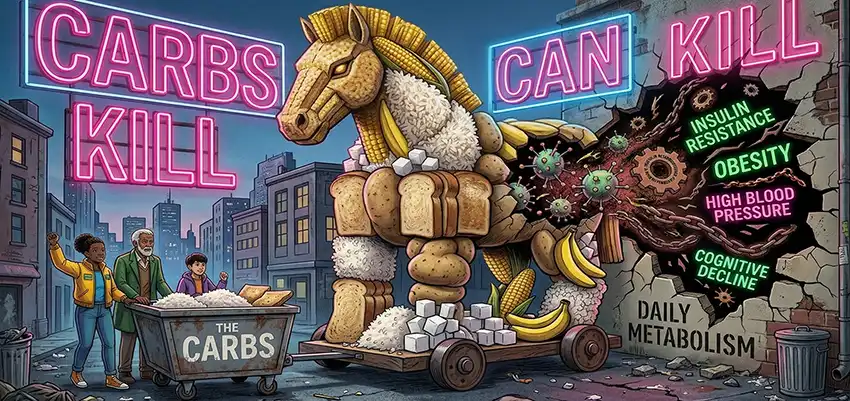
Contrary to most traditional nutrition advice, carbs should not be a major part of your diet, unless you are manual laborer. Sorry, that includes rice, breads, and fresh fruits. Excessive carb consumption leads to diabetes, obesity, high blood pressure, and cognitive decline. Choose your carbs carefully as occasional treats. Don’t let them rule your life.
Carbohydrates (carbs for short) are composed of carbon, hydrogen, and oxygen elements (but so are fats). For our everyday purposes, dietary carbohydrates include starches (rice, potatoes, corn, wheat), sugars (table sugar, fructose), and fiber (anything with comparable chemistry that humans can’t directly digest).
Carbs are made by plants through photosynthesis and serve multiple functions in a plant — energy storage and transport, cell walls, plant macrostructure, reproduction, even immune defense signaling. For contemporary dietary purposes, the important thing to remember is that they are quick and mostly easy-to-digest stores of energy (except fiber), becoming glucose (sugar) in the bloodstream.
Think of your bloodstream as an immediate fuel tank carrying glucose; your liver as a short-term energy storage tank for glycogen, and your body fat as a long-term stock of energy.
“Glycemic Index” (GI) indicates on a scale of 0-100 how fast a carbohydrate food is capable of raising blood sugar. This is broadly a function of how “processed” (or in a sense pre-digested) it is and how much fiber it contains. For illustration, rice has a GI of about 60, raw celery 15, potato chips 55, most breads 60-70, baked potato 85, maltodextrin (an additive in many supermarket foods) 100. Fruits run the whole range, from low to high GI, and like any other carbohydrate fructose becomes glucose in the blood. Though fruits have vitamins and phytonutrients, for weight-control purposes it is incorrect to think that you can consume as much fruit as you wish (or worse, fruit juice, which has no fiber to slow down absorption).
Insulin is a hormone which removes glucose from the blood and either provides it to cells as fuel, or stores it in the liver as glycogen. If “full up” on glycogen, the liver turns incoming glucose into body fat. Insulin is also needed to metabolize protein.
“Glycemic Load” (GL) is the Glycemic Index of a food, factored by the quantity eaten on any given occasion. It is a rough indicator of how much insulin will be needed to deal with the resulting glucose in your bloodstream. This is relevant because spikes in insulin can lead to your cells becoming “insulin-resistant”, so that your body is less and less able to regulate blood sugar levels.
Many nutrition sources advise keeping daily Glycemic Load below 100, or even 60, to maintain good insulin sensitivity. GL calculators are available online to help you plan meals. Just to get you started, a cup of rice, a bagel, McDonald’s Medium order of french fries, or a baked potato each have a GL of about 30; a can of soda, pizza slice, banana, or Snickers bar each have a GL of 15-20.
Many alcoholic drinks have carbohydrates (such as sugar in Mojitos), though alcohol itself is not one. However, alcohol is somewhat alien to human digestive systems, so when ingested it is metabolized before any of the normal food types (proteins, carbs, fats). Just to confuse you, a “sugar alcohol” is a total misnomer, referring to a subset of carbs which taste sweet but are hard to digest (and therefore have much fewer effective calories).
”Net carbs” is a term used by diet systems focused on carb restriction. It means the sum of the starch and sugar content of a food, while excluding the fiber and sometimes also the sugar alcohol grammage from the Total Carbohydrate count.
Allulose is a new sweetening agent which is technically a natural sugar (it’s found naturally in figs, though the stuff you can buy is processed from corn) but has just 10% of the effective calories. In case you find any products with Allulose as sweetener, you can also deduct the Allulose from net carbs. Allulose is “Generally Recognized as Safe” in the US, but is still not a permissible ingredient in Europe, which hasn’t yet come around to certifying it safe.
Plantation Bay’s Keto But Not Kwite Diet is based in part on carbohydrate restriction but not elimination — you can still have ice cream (especially if sweetened with Allulose) and an occasional pie or cake. More on this diet later in this series of articles.
1. Introduction. Protein Confusion?
3. Fats — Falsely Accused