Nutrition and Metabolism, Plantation Bay Assembles the Latest Science
by J. Manuel González, based on critical investigative research, and the mathematical evaluation of clinical trials supporting current health and nutrition advice. For Mr. Gonzalez's full background, please see https://plantationbay.com/cred.
3. Fats — Falsely Accused
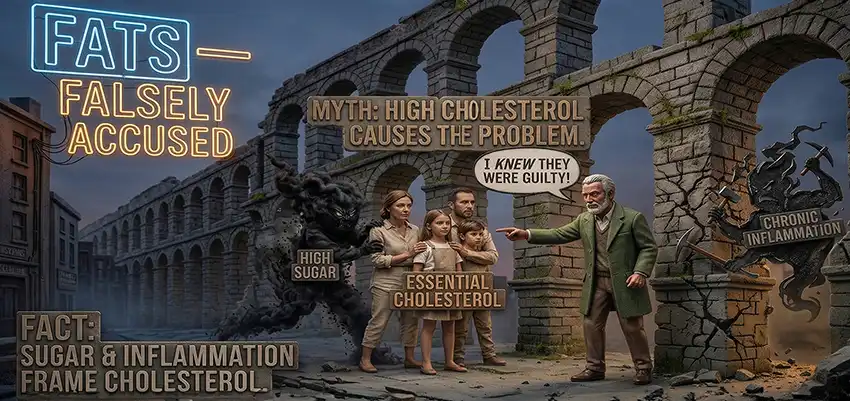
Disclosure: Plantation Bay’s opinion on this subject differs from current majority medical opinion, but our opinion is aligned with an ever-larger minority view and supported by the actual clinical evidence available. See Annex, “Available Clinical Evidence on Mortality Benefits of Replacing Saturated Fats with MUFAs and PUFAs — NONE”.
For practical dietary purposes, fats include visible animal fats, oil rendered from those fats (e.g., lard from pork and tallow from beef), and oils from plants (almost all from seeds of some kind, from coconut to jojoba, with notable exceptions being olive and avocado, whose oil is from the fruit pulp).
The function of fat in biology is to store energy for long-term future use, and this is true whether of animals or plants.
Like carbs, fats are composed of carbon, hydrogen, and oxygen, but differently arranged, almost always as three fatty acid molecules attached to a “stem” of glycerol (which is a sugar alcohol). Again for practical purposes, fats = triglycerides (“three fatty acids bonded to glycerol”). Olive oil, for example, is 99% triglycerides.
Your doctor may have convinced you that triglycerides are some kind of poison, causing bad things like “plaque”, and “calcium deposits”. In fact, they are just fats from fatty food you ate, or excess carbs that your liver converted into fats, both destined to become body fat.
Cholesterol is also a form of fat, though its function isn’t to deliver energy, but rather to serve as a material for hormones, Vitamin D, and most cells in the body. Many people also believe cholesterol is a poison, but it is necessary for life. Let’s dispel several myths surrounding cholesterol.
First, eating “high-cholesterol” food doesn’t lead to high cholesterol in your blood; much-maligned eggs are in fact among the healthiest foods to eat, and provide a lot of eating satisfaction that otherwise might be sought through starches and sugars, which are surely worse. Meta-surveys of competently-designed clinical studies have consistently failed to demonstrate any correlation between eggs and all-cause mortality or cardiovascular disease; however, many such surveys, though essentially concluding no risk from eggs, will find a way to label egg consumption pejoratively as “unproven to be healthy” or “maybe one daily is permissible”, possibly to avoid backlash from the Medical Establishment.
More about the Medical Establishment in further articles in this series, but for now, know that in my opinion the Medical Establishment is not as interested in your health as it is in Acting Important and Refusing to Admit Past Bad Advice.
Second, having high blood cholesterol (regardless of why) has also not been proven to pose any significantly higher risk of mortality. The Minnesota Coronary Experiment (1968-1973) conclusively demonstrated the opposite, in tightly-controlled conditions that can no longer be replicated (meal-by-meal measurement of food consumption for a captive inmate population over 5 years). Even the American Heart Association, a founding member of the Medical Establishment and leading proponent of lowering cholesterol and using statins to do so, was unable to deny the findings in a quick Abstract (https://www.ahajournals.org/doi/10.1161/01.ATV.9.1.129) though in most public pronouncements it still stoutly maintains the opposite. More on the American Heart Association later.
The Minnesota experiment ended in 1973, but the results were only revealed to the world in 2016, 43 years late. How that happened is an interesting story which I told in The Swindle of the Century, also available on the Plantation Bay website, (https://plantationbay.com/satfat). Disregarding the actual proven science, much of the medical world remains obsessed with blood cholesterol as a predictor of cardiac disease.
LDL (Low-Density Lipoprotein) Cholesterol is the so-called “bad” cholesterol, along with VLDL (Very-Low-Density-Lipoprotein). These are hypothesized “bad” because they deliver cholesterol to cells, but might stick to arterial walls. Someone, somewhere, said that if you could reduce LDL, then you would have less arterial constriction, on the theory that less raw material that could become a blockage means less blockage. Whoever that was, they forgot that LDL performs an essential function, which is to deliver raw materials to every cell in the body. Tampering with that function (such as by taking statins) ought to call for very, very careful weighing of pros and cons. Unfortunately, pros and cons are rarely heard on this subject.
The so-called “good” cholesterol is HDL (High-Density), which soaks up LDL and re-transports it to the liver, which eventually passes it through feces. You might think that the higher the HDL, the more janitors your bloodstream has, and the healthier you are. But it isn’t so. Abnormal HDL (very low, or very high) does correlate with higher mortality, probably because it accompanies some other major health issue; otherwise, a person’s level of HDL does not correlate at all with cardiac events or mortality.
So semi-knowledgable doctors focus on LDL as a cardiac disease predictor. But that ain‘t so, either.
A recent study (https://pmc.ncbi.nlm.nih.gov/articles/PMC10982736 — Kevin Kip et. al., 2000-2022) loaded the dice as well as it could, by choosing persons with past or present obesity for 35% of the population sample . Yet it was ultimately forced to conclude that, at best, the real-world effect of maintaining an “ideal LDL cholesterol level” of 100-190 was to reduce absolute 10-year all-risk mortality by 0.2% (2/10 of 1%), for a Number Needed to Treat of 500.
Number Needed to Treat asks how many people need to do what is being suggested, in this case keep LDL within that range by taking statins, for one person to benefit by not dying. So controlling your LDL cholesterol by whatever means (diet or taking statins like a good little patient) is a “lottery” that you have one chance in 500 of winning, mortality-wise. Rots of ruck with that.
And if you do win, you’ll never know it, because another approximately 489 out of 500 persons also didn’t die, and wouldn’t have died either way. If you don’t understand the arithmetic, don’t worry, because evidently most clinical researchers, and all pharmaceutical companies, don’t understand it either, or pretend not to.
Aware of the poor correlation between LDL cholesterol and actual cardiac disease, some doctors have migrated to another possible marker, ApoLipoProtein B (Apo B for short), a numerical count of the plaque-forming particles in a person’s LDL, which can vary significantly from the quantity of LDL.
However, Apo B doesn’t correlate well with cardiac events either, so some clinicians are hypothesizing that it’s also necessary to evaluate the interior “slipperiness” of arteries, as measured by a test called PLAC. A high number of plaque-forming particles, combined with poor slipperiness, are the recipe for unstable clotting, according to this latest theorizing.
Until more results on this theory are in, suffice it to say that LDL and HDL counts are not well-proven by clinical tests to predict cardiac problems, and you should probably not make life-altering decisions based on your LDL score, unless really extreme. You can have a “bad” LDL score and never have a cardiac event, or a good score and die tomorrow of a heart attack.
Unlike proteins and carbohydrates, fats when ingested do not require insulin to be processed into component fatty acids. If needed because glycogen in the cells has been depleted, fatty acids can be burned directly by cells for energy (with one important limitation which we’ll get into soon); if not needed, fats become storage fat, the white substance we normally think of as our body fat.
2. Carbs Can Kill
4. Fats — the Good, the Bad, and the Ugly (not the ones you think)