Nutrition and Metabolism, Plantation Bay Assembles the Latest Science
by J. Manuel González, based on critical investigative research, and the mathematical evaluation of clinical trials supporting current health and nutrition advice. For Mr. Gonzalez's full background, please see https://plantationbay.com/cred.
1. Introduction. Protein Confusion?
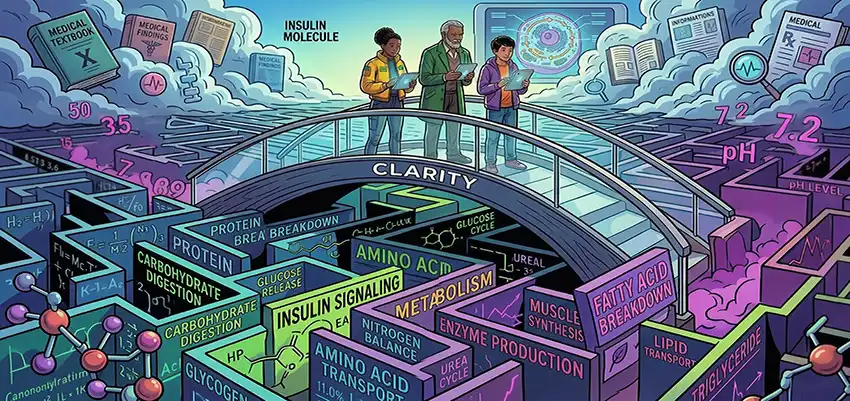
Most “medical findings” these days flow from clinical studies whose outcomes are expressed in numbers, probabilities, and statistical analysis. I am not a doctor but I understand numbers. Numbers “talk” to me. Some of them try to lie to me. Here are the stories that I get from certain numbers that claim to support certain medical recommendations.
This is not medical advice. Make your own decisions about your Nutrition and Metabolism, in cooperation with a responsible personal physician.
Large segments of the world population are facing health crises related to Nutrition and Metabolism, yet few people — and few doctors — know much about this subject. Unfortunately, most sources are either impenetrably nerdy or frustratingly simplistic. Other sources re-spout disproven beliefs. These articles aim to bridge these gaps, making complex science understandable and toppling outdated metabolism myths, all while turning scientific information into useful, actionable suggestions for better health.
The articles should be of value to many kinds of reader/viewer: dieters; those with metabolic or cardiac disorders; anyone interested in maintaining or restoring youthful good health; persons in doubt about recommended supplements and prescribed drugs; people with family histories of early cognitive decline, or who are already feeling some creeping neurological issues; and all persons who hope not just for long life, but for a good quality of life.
Based on extensive online research and AI-assisted data retrieval, these articles sometimes confirm, and sometimes disagree with, commonly-held beliefs about food, diet, and medication.
This is a large and complicated subject. Don’t expect a fully-unified explanation. Individual subjects will be covered with sufficient detail for lay persons to understand the most useful points on each subject, but not enough to earn a Ph.D. in Metabolism. However, rest assured: after each article, you’ll be better-informed about the subject than most doctors, many of whom unfortunately don’t keep up with modern developments in biology and science, or who don’t understand the deceptive mathematics behind “proven clinical studies”.
Intro: What Is In Food?
The most useful definition of food is that it is something that nourishes the body. By bulk and weight, food consists mainly of proteins, fats, and carbohydrates, in some combination of one, two, or all three, plus water. All food has “calories” — energy content.
In minute quantities, food also contains minerals (e.g., salt, copper, iron), vitamins (e.g., Vitamin A, B Complex, E, etc.), and phytochemicals (e.g., carotene from carrots, lycopene from tomatoes). There is some fuzziness between the last two. Both are “bioactive compounds”, but vitamins are considered highly desirable for human health, while phytochemicals are optional, possibly beneficial in different ways.
Proteins
Proteins consist of amino acids in various combinations, but there are about 20 “building-block” molecules out of which all the others are made. Amino acids are always made of carbon, hydrogen, oxygen, and nitrogen.
Dietary sources are meat (including seafood), dairy, eggs, and plants. With care, a Vegan diet can provide all the building-block proteins needed to maintain human health.
The main function of protein in human bodies is to serve as the material for muscles and organs. When eaten, proteins are metabolized (processed by the body) into component amino acids and immediately “transported” cell-to-cell to maintain muscles and organs, skin, hair, and nails. All of these processes require insulin, so consuming protein triggers insulin release. Any excess over the body’s immediate needs is re-processed by the liver into glycogen to burn a bit later for energy, and after that into body fat. More on insulin below.
2. Carbs Can Kill