Nutrition and Metabolism, Plantation Bay Assembles the Latest Science
by J. Manuel González, based on critical investigative research, and the mathematical evaluation of clinical trials supporting current health and nutrition advice. For Mr. Gonzalez's full background, please see https://plantationbay.com/cred.
6. Forbidden Fruit: a Very Basic Outline of Human Metabolism
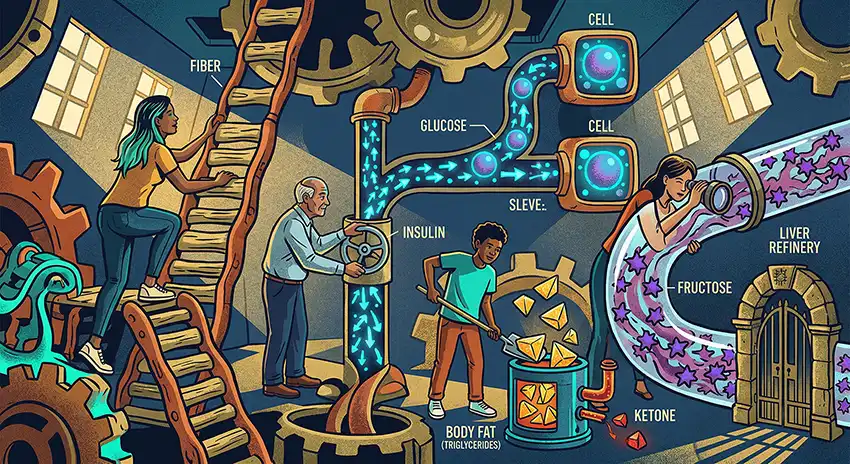
Most carbs are processed by the stomach into glucose, which enters the bloodstream and provides fuel for cell function. Excess ingested protein (not immediately needed for building muscle and tissue) may also get turned into glucose.
Through the blood, glucose is directly delivered to cells to fuel them.
The carbs that are NOT processed by the stomach are fiber and fructose.
Fiber passes through the stomach and eventually serves as a nutrient for your gut bacteria (the so-called probiotics which after eating fiber produce something useful for your health).
Fructose — the sugar in all fruits — eventually becomes blood glucose, but it is processed by your liver. Why fructose can’t be processed by your stomach merits some explanation. Sweet fruits and fructose are a relatively recent development (just 100 million old, a real newcomer in botany; trees by comparison are 400 million years old). Our ancestors probably never had enough fresh fruit to warrant a specific evolutionary adaptation, so fructose was left to our liver to manage, along with alcohol, toxins, and other “stuff my stomach doesn’t recognize”.
The invention of agriculture and orchard-farming made fruits readily available, but our bodies still consider fructose alien. Unlimited consumption of fruits is bad for you — fructose makes your liver do extra work, as alcohol does. Juice is worse — it has had the fiber stripped out, raises blood sugar fast, and is comparable to Coke with a few vitamins.
Also remember that a lot of supermarket “fruit juice” is just sugar with artificial coloring and artificial flavoring. Don’t indiscriminately give “fruit juice” to your children in the belief it is good for their health. Understand that it’s a “treat” and not a health drink. Accustoming your children to the sugar rush of fake or even genuine fruit juices may predispose them to crave sweets, the main highway that leads to obesity and health problems in young adults.
Eating either carbs or protein (but not fats) triggers the secretion of insulin by the pancreas. Insulin is needed to metabolize protein into simpler amino acids, but its better-known function is to deposit glucose in cells for immediate fuel, or store it as glycogen in the liver. If there are more carbs/glucose than can be stored as glycogen, the liver converts the excess into body fat. When needed (and sometimes even if not needed, for example in the middle of the night), the liver converts glycogen into glucose and releases it in the bloodstream.
When the liver’s stock of glycogen has been depleted and no new carbs are being ingested, the body then gradually shifts to burning body fat, either as triglycerides, or by converting body fat into ketones. (All of these “conversions” require adding or subtracting molecules with the help of hormones and enzymes.)
So, in a nutshell, the body can directly use only three kinds of fuel: glucose, triglycerides, or ketones. So long as you are giving it a steady supply of carbs, the body will use glucose. When new carbs aren’t being ingested and liver glycogen has dwindled, your body will mobilize body fat as triglycerides, and also start converting body fat into ketones for fuel.
One key takeaway here is that so long as you keep giving your body an ample supply of carbs and to a lesser degree proteins, it will NOT burn stored body fat.
5. Take Two: The “Good” Fat That Isn’t
7. Brain-Dead on Ketones?